
Forage Job Simulation
Kicking It Off
Today I’m kicking off the AIG Shields Up: Cybersecurity job simulation on Forage. This program promises a hands-on look at what cybersecurity professionals at AIG do day-to-day, and as a super eager aspiring security professional, I’m here to walk through it step-by-step while sharing my process, what I’m learning, and my honest take as I go.
Previously, I completed Forage’s Lyft software engineering simulation using Python and was really impressed with Forage and how much I learned. This time around, I want to jump into something I truly love — cybersecurity — and hopefully build skills that will help me grow in this field — while getting a feel for a “day in the life” of a security professional.
AIG background – according to AI overview via Google: “AIG, which stands for American International Group, Inc., is a leading global insurance organization. It provides a wide range of insurance solutions to businesses and individuals across approximately 190 countries and jurisdictions, according to AIG. AIG offers property-casualty insurance, as well as other financial services. The company operates through various subsidiaries and affiliates.”
Here’s the background for the task summarized: staying ahead of emerging vulnerabilities is crucial to prevent attackers from exploiting weaknesses before they’re patched. In this exercise, I’m reviewing recent publications from the Cybersecurity & Infrastructure Security Agency (CISA) — the government agency focused on reducing the nation’s exposure to cyber threats and risks.
After digging into the CISA reports, I’ll draft an email to the relevant infrastructure owner at AIG, communicating the seriousness of the vulnerability and the urgency to remediate it.
Task One
The first steps will be conducting an analysis of the recently disclosed — at the time –Apache Log4j zero-day vulnerability by researching official advisories from CISA. Following this, I will move on to assess AIG’s internal infrastructure to identify which systems are affected and determine the appropriate teams responsible. Finally, I will prepare a formal advisory communication to inform the relevant team leads about the vulnerability and recommend urgent remediation steps.
Currently conducting the analysis over the given sources: https://www.cisa.gov/news-events/cybersecurity-advisories/aa21-356a & https://www.cisa.gov/news-events/news/cisa-fbi-nsa-and-international-partners-issue-advisory-ransomware-trends-2021
Concluding notes I have been logging while reading: According to listed CISA sources
CSA: Log4j – Vulnerability = log4shell
Log4shell is a remote code execution (RCE) vulnerability affecting Apache’s Log4j library, versions 2.0-beta9 to 2.14.1.
Teams with Log4j may be affected by the vulnerability in question.
Log4Shell and CVE-2021-45046 listed as critical
and CVE-2021-45105 listed as high
any Java-based service or product that uses vulnerable Log4j versions for logging is at risk.
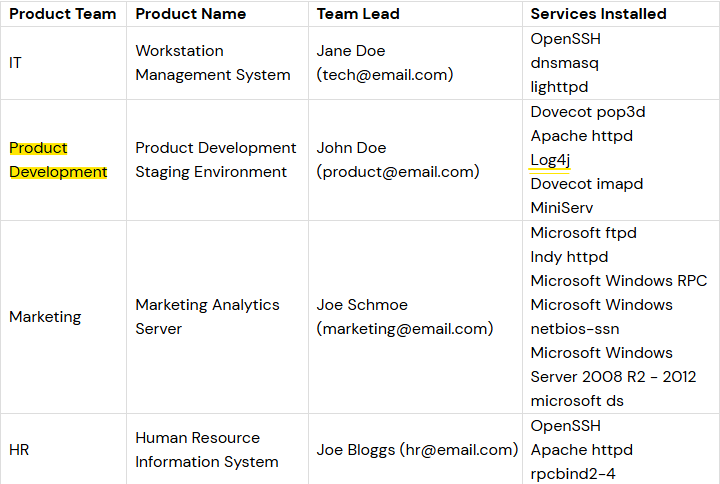
Based on my analysis and reporting so far, it is clear to see based on the high level infrastructure of teams below, the Product Development may be affected by the vulnerability.
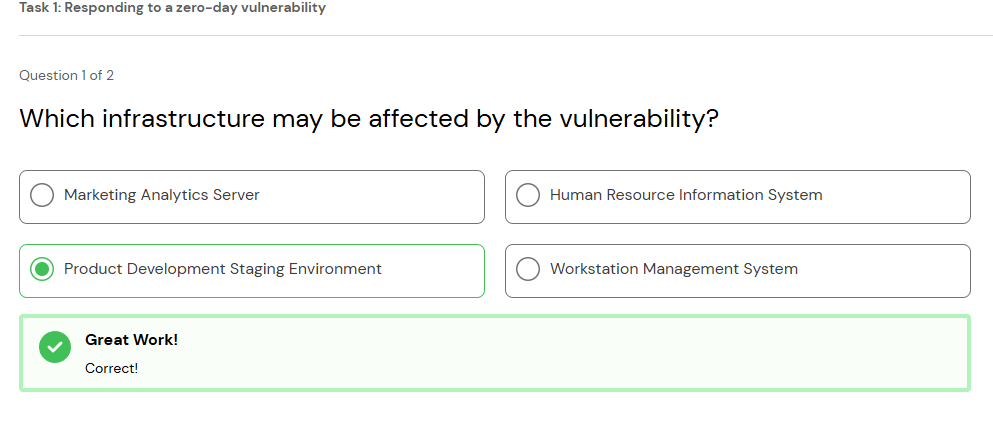
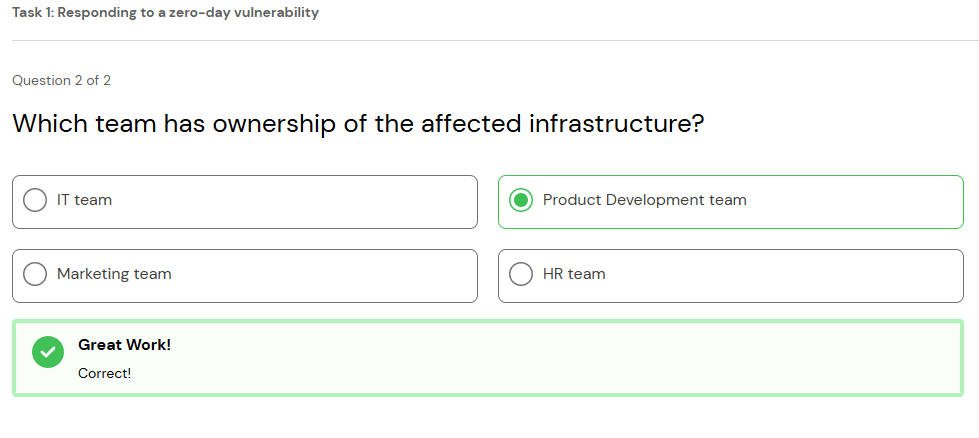
Questions answered correctly – shown below.
Based on the goal of this task, it is time to draft an advisory email to alert the infrastructure owner of the seriousness of this vulnerability. I am going to start by looking back over the reported notes I made, and referring back the infrastructure table and CISA sources as needed.
I just wrote a sample response that I would send to the correct product development team. Here is the submission:
Hello Product Development,
AIG Cyber & Information Security Team would like to inform you about critical vulnerabilities recently discovered in the Apache Log4j Java logging library that may affect Log4j.
The vulnerabilities—specifically CVE-2021-44228 (Log4Shell), CVE-2021-45046, and CVE-2021-45105—allow remote attackers to execute arbitrary code or cause denial-of-service conditions on vulnerable systems that use affected versions of Log4j (2.0-beta9 through 2.14.1). Exploitation is possible by submitting specially crafted requests that trigger the vulnerable Log4j logging process, potentially allowing full system compromise.
Given the widespread use of Java and Log4j across IT and operational technology environments, these vulnerabilities pose a high risk, including unauthorized access, data theft, ransomware deployment, and service disruptions.
To mitigate this risk, it is critical to:
Identify all assets and applications using Log4j within your environment.
Immediately upgrade Log4j to version 2.17.0 or later, where these vulnerabilities are patched.
If patching is not immediately possible, apply recommended workarounds or configuration changes from Apache’s official guidance to disable JNDI lookups.
Monitor logs and network traffic for signs of exploitation attempts.
Coordinate with Cyber & Information Security Team to report any suspected compromise.
Please confirm once remediation steps have been completed or if assistance is required to identify affected assets or apply fixes.
For any questions or issues, don’t hesitate to reach out to us.
Kind regards,
AIG Cyber & Information Security Team
Reactions so far – Task One
It’s been really eye-opening to see how a large company like AIG approaches vulnerabilities like this in a structured, practical way. Getting to step through the process — from researching official advisories to identifying affected teams and preparing formal communications feels incredibly real and relevant. Additionally, I want to note that this task has also made me tie in and appreciate my journey through Blue Team Level One even more as it shows how practically relevant that certification is, and how much value can be obtained from it.
This kind of hands-on simulation makes the daily work of cybersecurity professionals tangible, showing how critical clear communication and careful analysis are in protecting an organization. It’s motivating to practice these skills in such a realistic setting, and it’s exactly the experience I want to build as I move forward in my cybersecurity career.
Task Two
After sending off the advisory email, things have taken a turn. An attacker managed to exploit the Log4j vulnerability and tried to deploy ransomware on the affected server. Thankfully, the Incident Detection & Response team jumped in fast and stopped the attack before it could do major damage as only one zip file got encrypted — which the team does not have a backup for.
Now, the leadership at AIG has made it clear they won’t be paying the ransom. Instead, they want to see if we can crack the decryption key ourselves. I am now diving into this next challenge which sounds like a perfect mix of technical problem-solving and real-world urgency.
To start the brute force process, I am going to write a script using Python. The task provided the famous rockyou.txt file (as the attacker was quite unsophisticated) — which I will be utilizing in the script to brute force the unknown password.
This will be my first script written on my own and throughout the coding I will be utilizing AI tools and Google searches to complete this only as needed. The goal for this is to understand the process and be able to re-emulate in the future (or at least be able to quickly re-learn/adapt to a future problem).
Starting inn VSCode and with the template provided, I am currently working with this:
from zipfile import ZipFile
# Use a method to attempt to extract the zip file with a given password
# def attempt_extract(zf_handle, password):
#
#
#
def main():
print(“[+] Beginning bruteforce “)
with ZipFile(‘enc.zip’) as zf:
with open(‘rockyou.txt’, ‘rb’) as f:
# Write your logic here…
# Iterate through password entries in rockyou.txt
# Attempt to extract the zip file using each password
# Handle correct password extract versus incorrect password attempt)
#print(“[+] Password not found in list”)
if __name__ == “__main__”:
main()
I am more comfortable with iteration and decoding (second section) than the first section, so I will start here. I need to start by iterating over the opened rockyou.txt file using for password in f:
Next, confirming my reasoning with AI tools, I need to clean up the password using .strip. This seems to be correct and I end up with pwd = password.strip() /n print(pwd). Simply put, .strip is removing any leading or trailing whitespace characters from the password bytes.
Here is where I got choked up first and confused about the logic. After trial and error and consulting ChatGPT, it was clear that I needed to rewind and focus back on the first section (function) as I would have to call it in the second. After requesting a first step hint, I saw the given function from the template def attempt_extract(zf_handle, password): and this is a good start.
Because of the notes given in the template “# Use a method to attempt to extract the zip file with a given password”, I knew I was going to utilize try and except. However, I am not aware of the method to use but a simple Google search “method in python to extract all files from a zip” I got .extractall(), perfect! That leaves me with these lines of code. try: /n zf_handle.extractall(pwd=password) /n return True /n except: /n return False. This try and except code if extraction succeeds, it returns True. If extraction fails (wrong password or other error), the except block catches the error and returns False.
This concludes the first function and I am nearly done with the script! It is fairly simple from here. I just need to call back to the previous function in an attempt to extract using the current password! The full code will be pasted below! **NOTE** Please ignore any formatting errors as this code runs smoothly through any IDE.
from zipfile import ZipFile
def attempt_extract(zf_handle, password):
try:
zf_handle.extractall(pwd=password)
return True
except:
# Extraction failed
return False
def main():
print(“[+] Beginning bruteforce”)
# Open the encrypted zip file
with ZipFile(‘enc.zip’) as zf:
# Open the password list in binary mode
with open(‘rockyou.txt’, ‘rb’) as f:
# Iterate through each password candidate
for password in f:
# Clean password
pwd = password.strip()
print(pwd)
# Attempt to extract using the current password
if attempt_extract(zf, pwd):
print(f”[+] Password found: {pwd}”)
break
else:
print(“[-] Password not found in list”)
if __name__ == “__main__”:
main()
Final Thoughts
Wrapping up both tasks, I’ve got to say this has been a really eye-opening experience. Starting with the vulnerability analysis and advisory writing gave me a real sense of how large organizations respond to threats in the wild. Then moving into the scripting side, actually writing Python to brute-force a ransomware-encrypted file, was a whole different level of cybersecurity I have not yet fully dove into.
I learned a ton along the way, from digging into CISA advisories to thinking like an engineer when crafting a script that methodically tests passwords. It was challenging in the best way — not just theory, but getting my hands into the technical side. Definitely makes me want to keep exploring this engineering path, because it’s both fun and equally impactful.
